Author: Noah Arney

  • My Students Don’t Live in Their Parents Basement

    Stephen Poloz, of the Bank of Canada, had a rather tone deaf line the other day:

    “If your parents are letting you live in the basement, you might as well go out and do something for free to put the experience on your CV.”

    source

    That’s great for people who can do that, but most of my students live on their own, often with kids, and have been doing so for years.

    I understand where he’s coming from, and who he’s talking to, but it betrays a bias that he needs to get over. By saying things like this he’s ignoring the huge number of students who are barely getting by through their education, and are only going to school because they know it’s the route to a job that doesn’t pay minimum wage.

    (more…)

  • On Technological Change

    We always overestimate the change that will occur in the next two years and underestimate the change that will occur in the next ten.
    -Bill Gates


  • Someone Was Wrong on the Internet

    Today someone was wrong on the internet.  Yesterday someone else was. Actually a lot of people were wrong on the internet, and why does that bother us? I think we get bothered because we feel deep down that what we are doing/thinking/saying is right.  If we didn’t we wouldn’t be doing/thinking/saying that. Then we take that one step further and assume that because someone else does/thinks/says similar things to us on topic A that they will do the same for topic B.

    The daily show had a great bit a few weeks ago where the corespondent expressed shock that it was left leaning people primarily in the “anti-vaccination” movement. The idea that someone who agrees with us can also disagree with us shouldn’t be a surprise, and yet it is. In any large religion there are as many viewpoints as there are believers.  And some of those viewpoints are opposite each other. And some of those opposite viewpoints are over key tenets of the religion. Yet both are considered part of the region.  Similarly two people can have very similar views on child rearing but completely opposing views on the environment, or labour laws, or the advantages of ketchup or ranch as a condiment.

    (more…)

  • Paska Bread

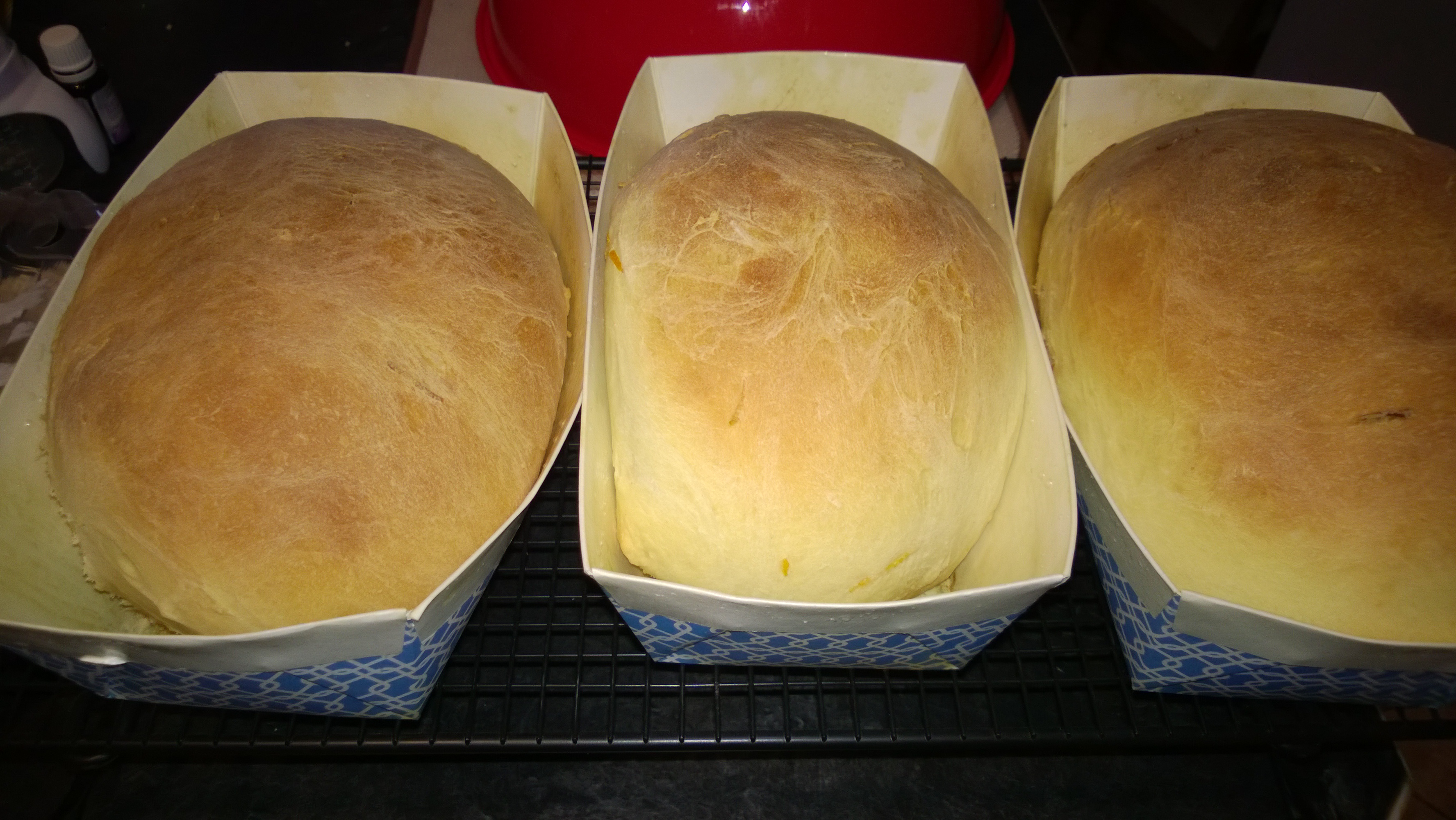
    I made some paska bread this week as it’s Easter Weekend.  As per usual it was delicious. Growing up we ate Paska for the week before and after Easter every year. We’d slather it with paska spread and it was like eating dessert for breakfast.  It’s a delicious filling Ukranian bread which here in BC is mostly eaten by Mennonites.

    In the interest of getting more people onto the paska bandwagon here’s my mom’s recipe.

    Paska loaves

    Traditionally this Russian Easter Bread was baked in round cans, and thus when the bread rose above the top, it formed a round dome reminding one of the domed Orthodox churches.

    (more…)

  • Starship Troopers Review

    Starship TroopersStarship Troopers by Robert A. Heinlein

    My rating: 5 of 5 stars

    Starship Troopers is, in my opinion, one of the three best military sci-fi novels ever written. It shares that distinction with Ender’s Game and Old Man’s war.

    It’s also a good primer on, in the books own words, “moral philosophy”. Though it’s main story is about Johny Rico’s time in the Mobile Infantry and their fight against the pseudo-arachnids (the bugs) most of the novel is the musings of Johny on morals, primarily through his remembrances of his “History and Moral Philosophy” teacher in high school.

    The basis of morality according to Heinlein (through his characters) is spelled out in the middle of Chapter 12: “Morals – all correct moral rules derive from the instinct to survive; moral behavior is survival behavior above the individual level – as in a father who dies to save his children.”

    (more…)

  • Review of The Forever War

    The Forever War (The Forever War, #1)The Forever War by Joe Haldeman
    My rating: 2 of 5 stars

    The Forever War may be a Sci-Fi classic but it shouldn’t be.

    Throughout the book we follow the main character as he goes through a series of unconnected scenes, like a bad documentary. Seeing a bit of everything the author imagines about the future. All this is punctuated with brief moments of exposition either spoken or by internal monologue. Instead of showing us the story that interconnects these snippets of the future we are told it, and it isn’t until over halfway through the book that we get our first moments of character development that isn’t told to us as a recap of what came between the last two scenes.

    The “love story” happens entirely off page, and there is almost no actual development of their relationship, again essentialy just being shown unconnected bits of the relationship without any of the important movement.

    In addition, this book is a perfect example of poorly written “hard” Sci fi. The author spends so much time explaining the technology, and so little time on character development and plot that to those of us reading it from the authors future are left only with a picture of what someone thought our present and future might be like, and with nothing else holding the novel together we can only shake our heads at how wrong they were, and how silly the portrayal of the future looks.

    View all my reviews
  • What I wish someone said to me in teachers college

    Welcome to education. I’m not going to say that you are potential teachers, because many of you will not pursue that as your careers. You are however educators. I once thought that was a buzzword but it means something very specific. You are embarking on a career in education. That might be teaching at the elementary middle or secondary level. It might be working as support staff. It might be working in a post secondary school as faculty or staff. It might be working for an educational support organization or company. What I’m trying to get at is the lessons you learn here will prepare you for not only teaching in a specific grade and subject, but will prepare you for working in the education field. And it is broad.

    According to statistics less than half of you will be teaching in five years. And that’s not a bad thing. This is not just job training, this is teaching you how to teach someone else. That skill is more than just “elementary, middle, secondary” and “math, English, science” it’s personal, it’s transformative, and it’s one of the most important things you will ever learn.

    So remember, you are educators.  No matter what profession or job title you have you will always be an educator and what you learn here will help you in any future path.

  • “Whether or not you can never become great at something, you can always become better at it. Don’t ever forget that! And don’t say “I’ll never be good”. You can become better! and one day you’ll wake up and you’ll find out how good you actually became.”

    ― Neil deGrasse Tyson