Tag: News and Politics

  • Changing Employee Cohorts and Retention

    Originally two twitter threads: thread 1 thread 2.

    It took everyone a bit of time to notice this year, but the labour market shortage is basically being driven by mass retirements over the last two years, just not where you think (is the cultural moment for a Madisynn MCU reference past? Probably). Employment stats time. All of this is some back of the napkin calculations from Stats Can’s info on people accessing retirement benefits and leaving or entering the workforce.

    We know people have been pushing retirements a bit later, and recent stats back this up. In the last 9 years, as this has been happening there’s been an average of about 100K new retirees under 65 in Canada. It took a dive during the pandemic of 8% and 10%. So more people retiring a year or two or five later than they used to. As with every other economic shock, the pandemic made more people avoid early retirement a little. So fewer people retiring under 65.

    What you might not know though is that the number of people retiring at 65 went up during the pandemic, up 5.4% for men and 6.6% for women. Interesting, yes? So during the pandemic fewer people retired early, but more retired at the standard age.

    But we also have stats for those who stayed in the workforce well past standard retirement age. For those still working at 70 or above the retirement numbers during the pandemic jumped over 300% for men and over 900% for women. It’s not quite as drastic for the 66-69 group, but it’s still significantly increased. So all those people who delayed retirement before the pandemic decided this was the right time to retire.

    The question everyone was asking as this labour market tightening happened was: where are the workers? Well the people who were working well past retirement age have now retired. And that might not seem like a lot, but it’s about an extra 100 thousand people (over 65) leaving the workforce over the last last two years than was expected, and that’s not counting the over 5,000 people in the 20-65 age group who died in Canada from COVID.

    So the Baby Boomers are retiring, as was foretold. We expected this. But, even more impactful, the incoming age cohorts are shrinking, the current group of teens is 20% smaller than the current group of new professionals. The preparing for retirement cohort is the same size as the new professionals cohort, so the labour shortage isn’t going to go away any time soon, because the group of replacement workers coming up isn’t big enough to make an impact.

    What does this mean for retention then? Employers need to adapt, because young people have something they haven’t had since before 2006: options.

    What was a shortage in manufacturing, construction, and retail in 2018 has now hit health care and professional roles, and it will just keep going. I’ve been thinking a lot about this with the discussion regarding work-from-home, return-to-work, quiet quitting / work to rule, skills gaps, and the labour shortage.

    If you want your employees to go above and beyond you need to offer one of these things:

    1. intrinsic rewards: motivates staff to want to do more, like work that is impactful or fulfilling or helps them grow and develop in the ways they want to.
    2. extrinsic rewards: pay for the extra time and effort either through overtime, bonuses, or other tangible rewards.
    3. career development: people will do more for you if their positions are secure or if they have a path to promotion.

    Once upon a time these three were considered standard in a professional role, but over time as the number of professional roles have grown, they’ve decreased. That probably was because of labour oversupply. Retirement age got later and more people finished university so the total # of people wanting professional jobs went up much faster than the number of jobs. But that started shifting about 4 years ago, and rapidly in the last year.

    The retirement bump that was promised in 2000 didn’t materialize until right before the 2008 recession, so the cohort ready to move into those jobs didn’t get them as they were cut. But the seeds of the labour shortage were there. 2012 saw an outlier level retirement group. After that things cooled off for a few years, then in 2015 they started picking up steam again, and by 2018 statisticians could see that there was going to be a labour shortage. COVID19 layoffs obscured it for a while, but now that those layoffs are over we can see the result.

    The labour shortage that was expected in 2000 didn’t happen, the one in ’06 was offset by the recession in ’08, and the delayed cohort of young people was more than enough to cover what should have been a shock to the system in ’12. But demographics keep marching on.

    We’ve expected it 22 years, and now it’s here, and that’s a very good thing for young people (if inflation and housing prices don’t destroy the gains). Employers, look at those 3 things, if you don’t offer them, then your employees will get snatched up by an employer who does.
  • Automation and Career Development

    This was originally a twitter thread

    I’m seeing a lot of people talking about how people should go into HS only jobs or trades instead of university. Lets put aside that the unemployment rate for trades is often worse than jobs that require a university degree, instead I’ll tell you a story about the economy.

    I grew up in BC. And the alternative to university that was pushed when I was in high school was either the family farm (I lived in a farming community) or the lumber industry. FYI, this is a #CareerDevelopment story.

    It was the 90s and the lumber industry was strong. If you weren’t from a farming family the non-university jobs talked about were forestry/lumber, construction, plumber/electrician, and first responders. In the mill towns it was pretty much just forestry/lumber.

    The forestry and lumber industry was very people intensive. People to cut trees, people to plant trees, people to move logs, people to run the mills, people to support all of those industries, people to work in secondary industries (wood product manufacturing).

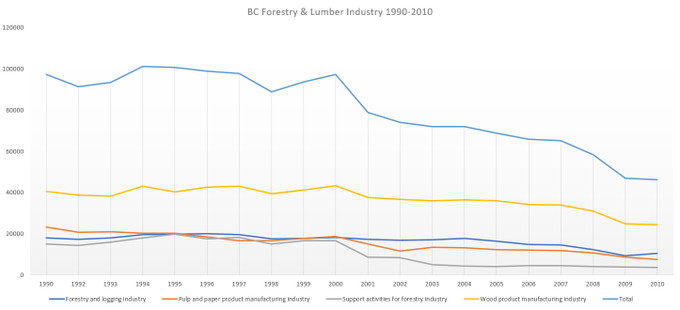
    So it’s the 90s and there’s about 100,000 jobs in the industry. They’re good jobs, well paid jobs. Most of them require no post-secondary or maybe a certificate.

    When I moved to Calgary five years ago the way people talked about the oil sands was exactly the way people talked about the lumber industry in BC when I was a kid.

    Now, I say that there were good jobs, and there were, but the number of jobs wasn’t really going up. And this doesn’t get noticed in the short term, but what it means is that the industry isn’t growing, which means the future won’t be bright for people trying to get in.

    Oh, productivity kept going up, the money the industry brought into the province kept going up, but employment was stagnant. That was never mentioned to teens looking to what their future could be though.

    So, what happened to that industry? Well, the 2000s happened. And at the end of it the industry had shrunk 50%. The 2000s were filled with talk about how we needed to “retrain” forestry and lumber workers.

    Magic bullet after magic bullet was proposed. The government started talking up trades, while ignoring the increasing trades unemployment rate. The jobs that had lower unemployment? Work that required a bachelors degree.

    FYI, here’s the Forestry & Lumber industry over 20 years. Yeah, it was bad.

    I talked in depth about the so-called Trades shortages about five years ago. TL:DR the only trades that have lower unemployment than bachelors degree requiring jobs are the ones that required two years of post-secondary apprenticeship program.

    That’s an important point a lot of people forget. Trades school in Canada is run through the same post-secondary system as Bachelors. The programs are generally 1/2 the length, but that’s it. So when I talk about post-secondary I mean Certs, Diplomas, Trades, and Degrees.

    What’s the point of this story?

    1. jobs that don’t require post-secondary are being automated
    2. once a resource extraction industry automates they never bring the jobs back
    3. people with post-secondary have an easier time changing industries when jobs disappear

    So, if you want to tell someone not to go to get a Bachelors degree, you’re still probably going to be telling them to go to post-secondary. That’s the way of the world now.

    As I look back on the people who talked up forestry when I was a kid I notice something. Most of them were let go when the mill automated or they changed industries in their late 40s. Some of them went to post-secondary then to retrain/reskill, and that’s a good thing.

    But here’s where it comes to Alberta. The same automation warning signs are there for the oil & gas industry. I had a student who I worked with a few years ago. He’d spent 15 years in the oil sands and decided to change jobs. Why? Because he saw the signs. He knew that his job was going to be automated in the next five years, so he decided to train now for the IT job that was going to replace 10 people who were doing what he was doing before.

    And that’s where we get back to #CareerDevelopment. Students need to learn not what the past industries were, but what industries are growing and flourishing. That is going to require post-secondary, of some kind.

  • Oh… Canada…

    Nobody is perfect. It’s a common saying, but let’s really break it down.

    No person, past or present, is perfect. They have all done things that are wrong.

    We like to play pretend. Let’s pretend that George Washington or Louis Riel or Abraham Lincoln was a saint. We like to pretend that the founding fathers of Canada cared just as much about diversity as we do, or at least that they didn’t oppose it. We like to put people like Martin Luther King Jr. on a pedestal and pretend that he only did the things we consider ‘good’ and none of the things we disagree with. Or Nelson Mandela, or Mother Teresa, or any other popular figure. But it’s just pretend. They’re all people, and people are flawed.

    Groups aren’t amorphous independent entities, they’re made up of people. Those people have good actions, and those people have bad actions, and those people do both at various times. However, humans like to think that any group that they are part of or want to be part of are defined by the best people in that group, while groups that they aren’t in or don’t want to be in are defined by the worst people in that group. So we get groups like Black Lives Matter, the GOP, Greenpeace, the Catholic Church, etc. The people in these groups have both good and bad actions. Sometimes it’s hard to see past our preconceptions of the groups and look at the actual balance of good actions and bad actions rather than looking only at the good actions of some groups and only the bad actions of others.

    Here’s the secret. It’s possible to identify both good and bad things in people or groups. It’s possible to celebrate the good while at the same time condemning the bad. It’s possible to be part of a group while knowing that there are problematic aspects to it. It’s possible to celebrate it for what it does while at the same time identifying where it falls short.

    Identifying problems doesn’t mean something isn’t, on balance, good. At the same time identifying good things doesn’t mean it isn’t bad. In fact our ability to identify good and bad in something and then make a decision with the full knowledge that it isn’t perfect or evil is an important aspect of our humanity.

    Lets talk about Canada.

    Fancy Bebamikawe said it well on Twitter today:

    https://twitter.com/FancyBebamikawe/status/880822465152372736

    It is possible to see both that Canada is pretty awesome and provides great things, like basic health care and education, while also seeing that it’s pretty bad and incarcerates Indigenous people for offences that white people get probation for or a fine, or that they under-fund education on reserves. These two things aren’t mutually exclusive. They’re what make Canada. Canada is both the good and the bad.

    You can like how the Prime Minister worked with the people who set the Tipi up on Parliament Hill for ceremony this week as being an example of reconciliation while at the same time understand that his fighting the implementation of Jordan’s principle directly harms Indigenous children (a fight that’s been happening for a decade now). You can like that the Prime Minister is increasing the education funding beyond 2% for the first time in two decades while hate that it was his party who first froze that funding, something that’s affected a generation and a half of Indigenous people.

    Look at things with both eyes open. There are very few things that are perfect, and discussing the tarnish on them doesn’t harm those things, but rather puts them in their proper perspective. You can be proud of Canada while at the same time understanding where it has fallen short of it’s ideals. You can be proud of Canada while at the same time understanding that it’s historic ideals were what we’d call racist or regressive now.

    You can be proud of Canada while pointing out its flaws.

    Oh… Canada… we can be proud and aware at the same time. That doesn’t make us non-patriotic, but rather makes us better humans and better Canadians.

  • Andrew Scheer and Memes

    UPDATE August 29, 2019: Abortion rights: Scheer has now announced that he holds the opposing position from Harper. He is willing to allow MPs to bring forward private members bills on abortion and same-sex marriage and allow a free vote.

    UPDATE June 4, 2019: Yes, I’ve seen that a number of people are referring back here to try to defend Scheer, however, as you can tell, this was written two years ago, as was the original meme. It only applies to him at that point and before. Everything he’s done since is not covered in this. Look it up, research it, think about it, read actual news rather than commentary or opinion pieces.

    Original post, June 1, 2017:

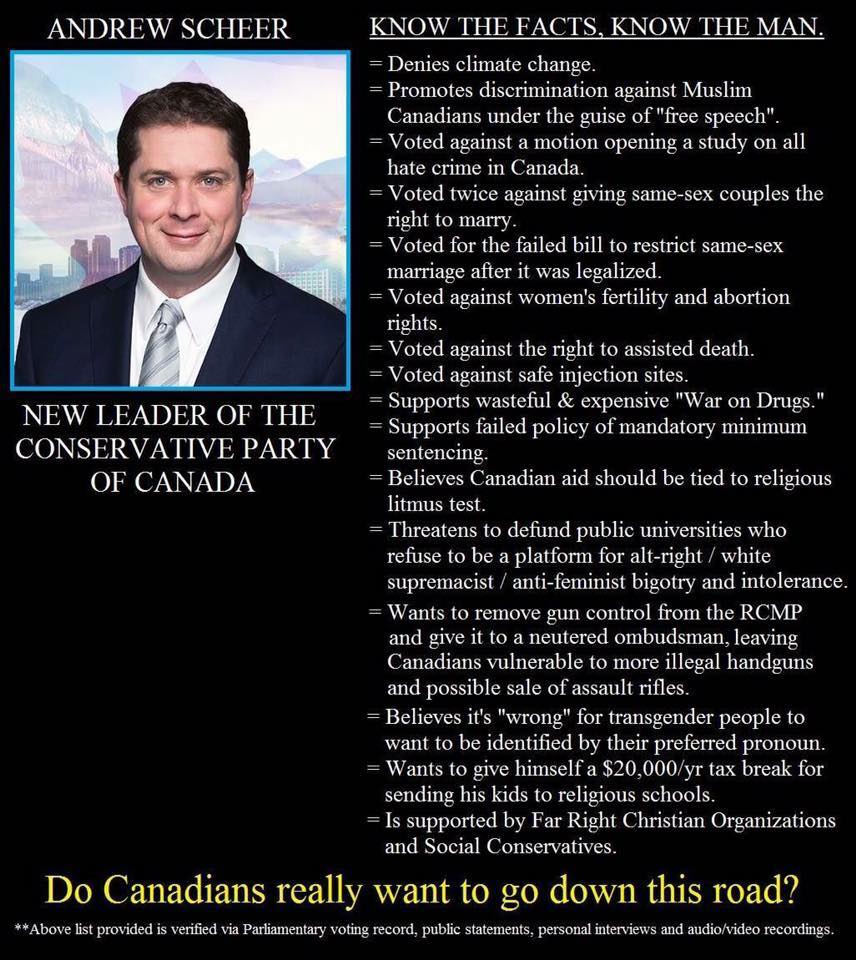
    If you’ve read my writings during the last election I was very very critical of the CPC. That being said I hate it when people are deliberately misleading. I saw a meme today about the new leader of the CPC Andrew Scheer.

    It seemed to list things that I had heard the opposite about so I looked each item up. Here’s what I found.

    Looked it up. The meme is very wrong on some things but right on others.

    (more…)
  • Dobson, Trump, Faith, and Power

    The major Evangelical leader Dr. Dobson has put out a release talking about Donald Trump’s faith. Now I was under the impression that there was no “religious test… as a Qualification to any Office or public Trust”. But since Dobson brought it up… in the words of Aaron Burr in Hamilton “Ok, so we’re doin’ this”.

    His post on “Culture Watch” is available here.

    Let’s break it down:

    Only the Lord knows the condition of a person’s heart.  I can only tell you what I’ve heard.  First, Trump appears to be tender to things of the Spirit.

    Yes, that’s true. Only the Lord knows. However, the bible says a few other things about the heart:

    Luke 12:33-34: Sell your possessions, and give to the needy. Provide yourselves with moneybags that do not grow old, with a treasure in the heavens that does not fail, where no thief approaches and no moth destroys. For where your treasure is, there will your heart be also.

    Do we want to consider where Trump’s treasure is? We don’t need to ask, he talks about it time and time again.

    (more…)
  • Republican Candidate Prediction

    14 candidates step in, one steps out. Hey that could be an interesting TV show. But since we don’t do this by cage match who has a chance at winning the Republican nomination?

    Alright, I’m going to cut out anyone who polled lower than one percent on any of the polls in the last week. I’m basing that on the polls available here which is:

    • RCP Average
    • FOX News
    • Quinnipiac
    • NBC/WSJ
    • IBD/TIPP
    • CBS/NY Times

    So with that we have:

    • Carson
    • Trump
    • Rubio
    • Cruz
    • Bush
    • Fiorina
    • Kasich
    • Paul
    • Huckabee
    • Christie

    Sorry Santorum, Jindal, Graham, and Pataki you’re out, but you’ll have company soon.

    (more…)

  • Why I Can’t Vote Conservative Any More

    I am an ex Conservative voter. I maintain that I didn’t leave them, they left me.

    I have voted for three different parties in the four federal elections I’ve participated in, only the Conservatives twice. The two Conservative MPs I’ve voted for both have my respect. They are good people. They have done great things for their constituents. One of them was such a great MP I debated becoming a party member. The conservatives have done some good things while they’ve been in power. The repealing of Section 13 of the Canadian Human Rights Act was a good move. I was writing about it back in 2008. I also have high praise for Jim Flaherty. He was a great finance minister and I feel that the Conservatives successes with the Canadian economy should be attached to him and not to Stephen Harper. I also wonder what he would have thought about Harper criticizing Trudeau that you shouldn’t run a deficit in a recession, when that is exactly what Flaherty did to help the Canadian economy during the recession in 2008.

    But, I can’t vote Conservative again.

    I can’t vote Conservative because I can’t align my faith and beliefs with it.

    (more…)

  • Canada’s Response to the Refugee Crisis

    This post has been percolating for over a month now. So sorry it’s a bit long but I like giving facts and doing my best to not misrepresent people. I don’t often include Bible verses on my blog but today I am.

    Matthew 25:34-36

    Then the king will say to those on his right, ‘Come, you who are blessed by my Father, inherit the kingdom prepared for you from the foundation of the world. For I was hungry and you gave me food, I was thirsty and you gave me something to drink, I was a stranger and you invited me in, I was naked and you gave me clothing, I was sick and you took care of me, I was in prison and you visited me.’

    A few weeks ago I asked my local MP (the Honorable Ed Fast) about Canada’s response to the war against ISIS and the refugee crisis that has been made immeasurably worse because of it. I agree with MCC on this in that a lasting solution needs to be a non-military solution that removes or reduces the reasons for radicalization and works toward peace. I was concerned that the Prime Minister seemed to be advocating for more military action because of the refugee crisis.

    His response was:

    “With respect to the Syrian conflict, let me correct you by saying that the Prime Minister has not advocated for MORE military action (as you have suggested) but for a balanced approach which includes three pillars: humanitarian assistance (of which Canada is one of the world’s largest donors), military intervention and resettlement of refugees. We do not have any plans to increase our military presence in Syria and Iraq.”

    (more…)